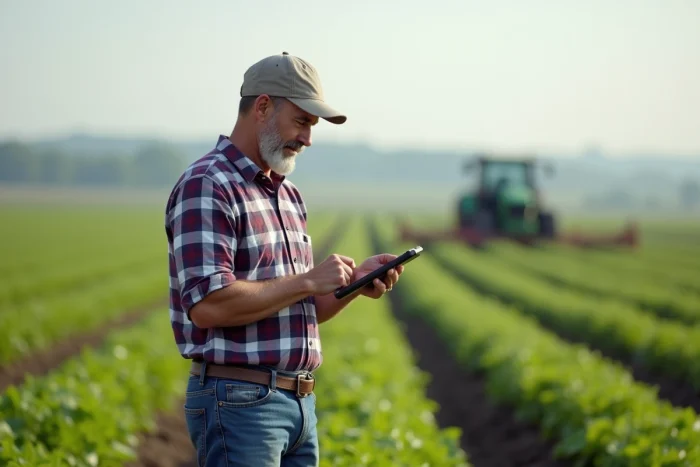
One hectare of wheat today provides a wealth of seasonal data that would make many European SMEs blush over their entire year. Yields sometimes reach new heights, but in certain rural areas, productivity falters under climate pressure and resource scarcity. Despite technological investments exceeding $20 billion in 2023, only 12% of operators actually use all the digital features available.
The smart wave does not wait: robots, AI, connected sensors, everything is interwoven to completely transform the habits of professionals. This upheaval does not just automate; it propels agriculture towards a path of more sustainable and resilient management.
Overview of Technologies Revolutionizing Agricultural Management
Digitalization is no longer confined to grand speeches. Today, it involves sensors scattered across fields, connected weather stations, and drones that silently monitor. Farmers observe, analyze, cross-reference data, and rely on facts for their decisions. Instinct and routine give way to precision agriculture, where management is refined throughout the seasons.
The quest for traceability and efficiency is accompanied by digital tools that support operators in the field. A simple network of sensors is enough to measure soil moisture or temperature in real-time, continuously transmitting these valuable indications. This information provides a comprehensive picture of crop health. Intelligent agricultural machines manage inputs with precision. The days of blind interventions are over: every action becomes targeted, every resource adjusted.
Now, platforms centralize weather data, past yields, soil needs, and updated parcel tracking. This management, once reserved for large structures, is opening up to more farmers. Of course, barriers remain: financial investment, learning time, and sometimes irregular networks. But advancements are translating into optimized harvests, better resilience, and reduced environmental impacts. To delve deeper into the topic and discover testimonials from farmers, learn more about Agri Systems.
How is Artificial Intelligence Transforming Farmers’ Daily Lives?
Technology did not burst onto the scene with a bang, but its effectiveness is relentless. Artificial intelligence relies on the multitude of data collected by sensors, drones, or satellites. Each plot becomes a source of information, processed and then converted into directly usable indicators. Now, decisions are no longer made on instinct but are based on a truly contextualized analysis.
The decisive step? Making these numbers speak so they produce concrete results. Preventing the onset of diseases, adjusting fertilization according to actual growth, planning irrigation to the hour: agricultural management resembles a precise score, where each action is triggered at the right moment. Ultra-local maps derived from GIS reduce approximations. Efficiency rises, waste declines.
Among the tangible developments enabled by this technological wave, we can cite various benefits:
- Anticipation of pest attacks through machine learning models
- Optimization of fertilization and irrigation thanks to real-time data processing
- More precise planning of sowing, based on historical data and predictive weather
Digital agriculture is no longer just about productivity: it allows for tailored decisions based on soil analysis, climate, or the choice of cultivated varieties. The impact? It’s no longer just a matter of yield. It’s primarily a way to navigate uncertainty, to progress despite the unexpected, and to best preserve every resource. When farmers learn to read their data, they stop being passive: they anticipate, decide, and become authors of their trajectory.

Towards Sustainable Agriculture: What Challenges and Opportunities for Farmers?
The agricultural transition is gaining momentum. Adopting new solutions is not just about modernizing the workshop: it also means reducing inputs of fertilizers and pesticides, leading to a tighter environmental footprint. Continuous data collection makes each operation more relevant, limiting excesses and preventing losses as well as unnecessary waste.
Product tracking is becoming the norm. With blockchain, every step from field to table is recorded in a secure ledger. This transparency appeals to increasingly vigilant consumers regarding the origin and guarantee of what they purchase. For the farmer, it’s a gain in trust and recognition of their work.
Meanwhile, marketing is evolving at breakneck speed. Online sales platforms and connected lockers directly connect farmers and customers, limiting intermediaries, ensuring profitability, and guaranteeing better recognition of the profession. The farmer, more autonomous, moves towards sustainable agriculture without sacrificing their margins.
To shed light on current transformations, here is a summary of the major advantages observed on the ground:
- Significant reduction in inputs
- Continuous optimization of methods through field analysis
- Securing and tracing agricultural information
It’s hard to ignore the ongoing changes: adaptation is no longer optional; it’s a matter of sustainability. Technology advances, and each harvest opens up new perspectives. Who will still choose to cultivate the future blindly?