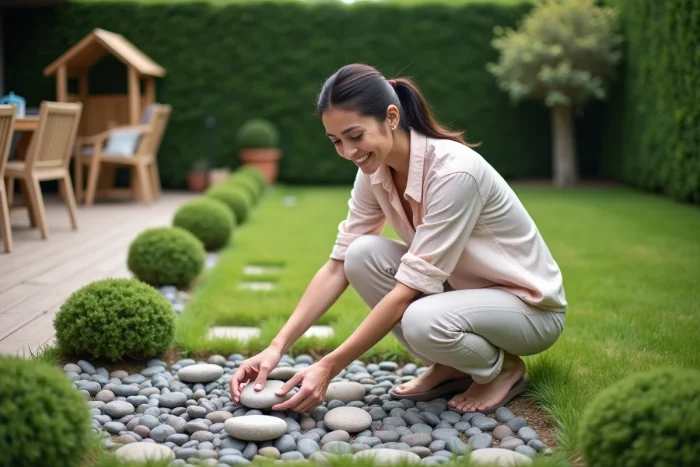
The surroundings of a house never fully adhere to the grand laws. Urban planning rules set the framework, of course, but the simplicity of the constraints often leaves room when it comes to structuring paths, borders, or nooks. The result: real solutions to invent, where others see limits.
Creating a garden that is as welcoming on a daily basis as it is pleasant to stroll through is all about choices. It is often believed that one must sacrifice appearance for practicality, or make multiple compromises as soon as one wants to fit everything into a single space. However, when one embraces mixing uses, corners, and desires, the puzzle comes together much more naturally than it seems. Every square meter adapts: play area, terrace, reading nook, gourmet patch… And suddenly, the garden articulates itself as an obvious choice, modular and alive.
Why structuring your garden into different spaces changes everything
Clearly defining the purpose of each part of the garden transforms the whole into a place designed for life. A garden designed in zones is an organized whole like a house: each nook has its role. A few examples speak for themselves:
- A terrace where meals are shared with family or friends
- A relaxation corner under a pergola for a break
- Paths designed to easily reach the shelter or vegetable garden
- A lawn for laughter, stretching, running
- Crops or an orchard placed in a sheltered spot to protect demanding plants
This segmentation does not fragment: it fluidifies. One moves freely from one atmosphere to another, and the garden seems larger, with each zone asserting its personality. Gone are the cluttered spaces where everything piles up, coexisting without breathing room.
Thinking about layout means designing a coherent framework. Plant borders, low hedges, walls, and open fences set markers, never walls. A flowered strip tempers the transition, while a path invites you towards a shed or a bench in the shade. A refreshing pond, an easily accessible raised vegetable garden, a fountain at the corner of a terrace animate without cluttering. Everything responds to each other: functionality serves aesthetics, and biodiversity is invited where it was barely hinted at.
Want to push the organization further, to create a custom garden? Sometimes it just takes expanding the palette of ideas, exploring new or inspiring approaches. To find concrete ideas and visualize well-thought-out arrangements, feel free to discover Info Jardinage.
What elements to consider for imagining a functional and pleasant garden?
A garden designed for real life is first sketched by taking the time to observe. Sun, wind, differences in level, clay or light soil—all of this guides the choice of materials, the plant palette, and how to distribute the spaces. In the end, one composes from the existing, never seeking to bend nature to the rule of a fixed plan.
In terms of styles, there is something to satisfy every desire: the mineral simplicity of a zen garden, the lush English-style forest, Mediterranean abundance, the conviviality of a country garden. Everything starts with lifestyle, concrete needs: dining outdoors, letting children play, cultivating, gathering away from prying eyes…
Precisely identifying expectations is crucial for adjusting the organization. One can thus draw up a clear list of zones to integrate:
- A well-placed dining area
- A clear space for games or relaxation
- The growing corner, herbs, or vegetable flowers
- A peaceful zone to recharge or read in the summer
To these wishes, one overlays the reality of the site and maintenance: favoring resilient plants suited to the region, reducing lawn areas if watering becomes scarce, relying on mulching or rainwater harvesting to limit effort and resource expenditure.
The choice of materials gives an identity: warm wood, durable natural stone, recycled slabs or fences to affirm a committed approach. The furniture follows the same logic: it aligns with the spirit of the place and the house, while the lighting highlights perspectives, creates focal points, and accentuates transitions from one zone to another. It is better to dose, to care for each detail to avoid accumulation and leave a real space for local biodiversity.
During the design phase, sketch scaled plans or use a 3D tool to test borders, organize access, plan irrigation, or the placement of lights. This way, the garden takes shape like an additional room, tailored to your uses and the history of the land.

Concrete tips for creating harmonious and personalized zones
Structuring your garden into functional spaces does not require partitioning. There are several simple tips to suggest boundaries, rhythm the view, and organize movement:
- Low walls, stone borders, or light hedges to materialize without blocking the view
- Perennial flower beds or flexible hedges that allow light to filter through and welcome birds and pollinators
- Gravel paths, slabs, or stepping stones to naturally guide passage
Each zone has its signature plant or accessory. A nap corner gains intimacy with a pergola covered in star jasmine; the raised vegetable garden stands out thanks to its wooden edges; the children’s area is set on a welcoming lawn, quietly enclosed by flowers or a rounded wall that reassures. Always, functionality refines aesthetics.
To vary uses in a small space, favor modular furniture and clever tiered storage. Multiply vertical plans: trellises for clematis or climbing beans, green walls, pot hangings. Low-voltage lighting, garlands, and lanterns dress up the evenings without overloading the decor. Choose your plants based on their ability to enhance the place: a climbing hydrangea brings freshness to a screen, marigolds color the edges of a path, heather enhances a shaded corner. Playing on the diversity of textures and varying foliage ensures a balance that never tires the eye.
A discreet pond, a small fountain, a raised vegetable garden inject rhythm and comfort. Gentle passages between spaces, the use of natural materials, and the thoughtful choice of each plant gradually weave a harmonious garden, where one enjoys gathering as much as contemplating. Sometimes, a simple stepping stone or a light hedge is enough to give presence, charm, and soul to the whole. Ultimately, every garden can become this little world where everything is invented, tried, and savored, as long as one dares to adjust, modulate, and surprise.