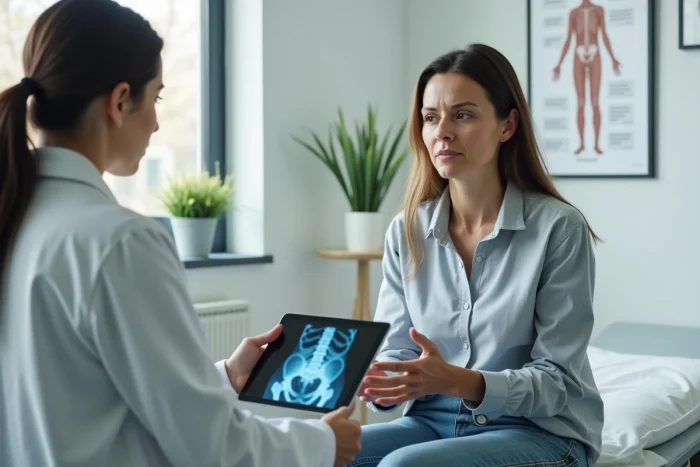
Up to 40% of radiological examinations reveal the presence of pelvic phleboliths, often discovered by chance. Contrary to popular belief, these calcified formations are rarely indicative of serious pathology but can sometimes mask underlying disorders.
Unexplained pelvic pain or urinary symptoms may lead to a more complex diagnosis, combining phleboliths and pelvic varices. Solutions are not limited to monitoring: a range of tailored treatments exists to reduce discomfort and prevent complications.
Phleboliths and pelvic varices: what exactly are we talking about?
Pelvic phleboliths are as intriguing as they are puzzling. These small calcified masses, true stones nestled in the veins of the pelvis, are the result of a silent process. Blood circulation slows down, sometimes stagnates, and calcification occurs where venous flow weakens. Often, this phenomenon develops quietly, against a backdrop of thrombosis history or venous malformations, promoting the appearance of these formations.
Sometimes, phleboliths are not alone. They share the space with pelvic varices: the veins of the small pelvis, such as the ovarian vein, the saphenous vein, or the inferior vena cava, dilate persistently. These chronic venous dilations can generate a pelvic congestion syndrome, where a feeling of heaviness, persistent pain, and recurrent gynecological disorders intertwine.
Everything can be explained by blood stagnation. Where blood circulates poorly, congestion promotes the formation of phleboliths, but also the establishment of varices, especially if factors such as multiparity or hormonal disturbances are added. To delve deeper into this dynamic and explore the mechanisms further, the specific section pelvic phleboliths and their causes details the subtleties of these processes.
| Term | Definition |
|---|---|
| Phlebolith | Venous stone formed by the calcification of a clot in a pelvic vein |
| Pelvic varix | Persistent dilation of a pelvic vein, often a source of pain |
This table highlights the difference between these two entities, which often intersect but do not overlap. Each has its own issues, but both stem from the same fragility of venous circulation in the pelvis.
What signs should raise concern and how to recognize possible causes?
The onset of chronic pelvic pain is never trivial. Discomfort settles in, diffuse, sometimes heavy in the lower abdomen, often more pronounced at the end of the day. When this pain lingers in daily life for several months, it becomes relevant to consider the possibility of pelvic phleboliths or pelvic varices, especially in women of childbearing age.
Some signs are unmistakable: pain during sexual intercourse, worsening when standing for prolonged periods, more intense symptoms during menstruation. Discomfort may radiate to the back, the lumbar region, or even the inner thighs. Sometimes the malaise takes on a cyclical nature or intensifies depending on the posture adopted throughout the day.
Here are the most frequently encountered symptoms:
- Pelvic pain at rest or with exertion
- Heaviness sensation at the end of the day
- Pain during sexual intercourse (dyspareunia)
- Worsening when standing for prolonged periods
On the causes side, several factors combine: multiparity, hormonal imbalances, venous malformations, history of thrombosis or pelvic phlebitis. A clot can pave the way for the creation of a phlebolith, sometimes with significant repercussions in daily life. Only a careful clinical evaluation, combined with a precise interview, can lead to the correct diagnosis, especially when symptoms have no obvious explanation.

Effective solutions to relieve and treat pelvic venous disorders
Everything begins with a rigorous identification of the problem. The clinical examination lays the groundwork, but often, imaging makes the difference. Venous Doppler ultrasound, pelvic MRI, sometimes phlebography or CT scan: these techniques allow for precise localization of varices and phleboliths, measurement of congestion, and assessment of the severity of the situation. The doctor then adjusts the treatment strategy to each profile.
Among the proposed solutions, medical venous compression can provide notable relief. By promoting circulation, it slows the progression of venous disorders in the pelvis as well as in the legs. In addition, non-steroidal anti-inflammatory drugs (NSAIDs) or a progestin can alleviate pain. In the case of thrombosis, anticoagulant treatment is necessary, always under close medical supervision.
Embolization: a reference solution
For many patients, embolization of pelvic varices transforms daily life. This procedure, performed by an interventional radiologist, involves obstructing abnormally dilated veins. A microcatheter is introduced, and then a sclerosing agent or small beads are injected to interrupt circulation in the targeted vein, whether it is the ovarian vein or the saphenous vein. The intervention, under radiological control, targets the source of the pain. The effectiveness is often evident: recurrence decreases, and quality of life improves.
Other options are adjusted according to the situations: sclerotherapy, drug treatments, or adaptation to the nature of venous malformations. The goal remains the same: to restore venous balance, limit long-term risks, and allow everyone to regain a life free from the burden of pelvic pain.
In the face of these discreet yet impactful disorders, a tailored approach makes all the difference. At the end of the journey, it is no longer discomfort that dictates the day, but the return to serene mobility, free from the heaviness that has been endured for too long.