The letter Z is the rarest in the French anatomical vocabulary. It refers to only a handful of structures, some of which fall under strict medical terminology and others under slang or comparative morphology. Distinguishing these registers is the starting point for understanding what the body parts beginning with Z actually encompass.
Zygoma and zygomatic bone: the same facial bone under two names
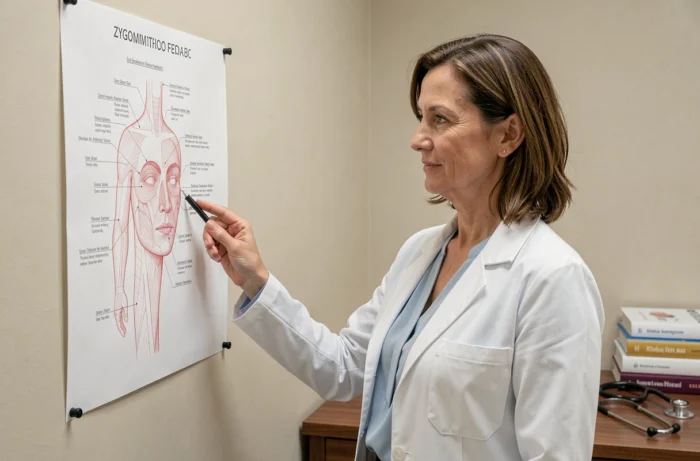
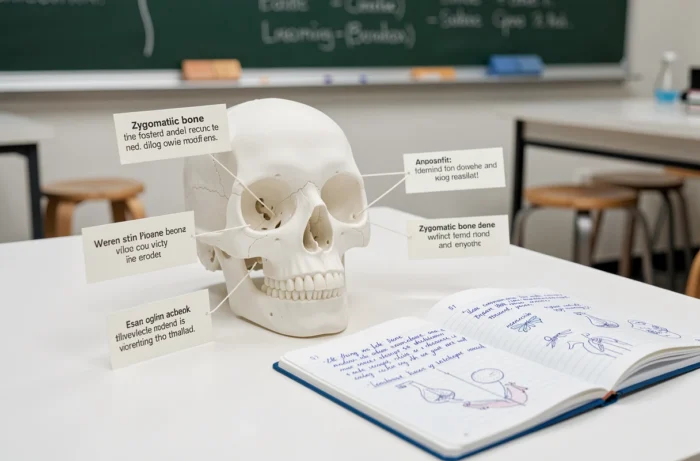
The zygoma is the anatomical term for the zygomatic bone, a paired bone located in the lateral part of the face. It forms the cheekbone and contributes to the outer wall of the eye socket. According to the Terminologia Anatomica, an international nomenclature published by the Federative International Programme for Anatomical Terminology, both names refer to the same bony structure.
Several online lists present “zygoma” and “zygomatic” as two distinct body parts, which can be confusing. In anatomy, “zygomatic” functions as an adjective: it qualifies the bone itself, but also the zygomatic arch (the bony bridge connecting the cheekbone to the temporal bone) and the zygomatic muscles, responsible for smiling. Listing the parts of anatomy starting with z thus requires clarifying this distinction between the name of the bone and the structures that depend on it.

The zygomatic arch can be easily palpated by running a finger between the corner of the eye and the ear. It is a clinical landmark used in maxillofacial surgery and osteopathy. The small and large zygomatic muscles insert on this bone and pull the corners of the lips upward and outward.
Ciliary zonule: the ocular structure that allows focusing
The ciliary zonule (or zonule of Zinn) refers to a set of fibers stretched between the ciliary body and the lens, inside the eye. These fibers form a sort of suspension ring that keeps the lens in place and transmits the contractions of the ciliary muscle.
This mechanism has a specific name: accommodation. When the ciliary muscle contracts, the zonular fibers relax, the lens becomes rounder, and near vision becomes clear. Conversely, when the muscle relaxes, the fibers tighten, the lens flattens, and distance vision improves. According to the American Academy of Ophthalmology, the ciliary zonule is the central mechanical component of visual accommodation.
In pathology, rupture or relaxation of the zonular fibers can lead to lens dislocation. This phenomenon is observed in certain connective tissue diseases. It is also a concern during cataract surgery, where the surgeon must assess the strength of the zonule before removing the opacified lens.
Zeugopod: a term from comparative morphology, not common medicine
The word zeugopod regularly appears in lists of “body parts starting with Z,” but its status deserves clarification. It does not refer to a specific organ or bone of the human body. In comparative morphology, the zeugopod corresponds to the intermediate segment of a limb in tetrapods (four-limbed vertebrates).
In humans, the zeugopod of the upper limb corresponds to the forearm (radius and ulna), while that of the lower limb corresponds to the leg (tibia and fibula). This vocabulary comes from the classification of limb segments used in evolutionary anatomy to compare body plans between species.
- The stylopod refers to the proximal segment: arm (humerus) or thigh (femur)
- The zeugopod refers to the intermediate segment: forearm or leg
- The autopod refers to the distal segment: hand or foot
A doctor would not use the term zeugopod in a clinical report. It remains confined to courses in evolutionary biology and comparative anatomy, where it serves to describe limb homologies among mammals, reptiles, and amphibians.
Familiar or regional terms: zakar, zébi, zob and anatomical false friends
Several words starting with Z circulate in lists for games or vocabulary challenges: zakar, zébi, zob, zigomar. These terms do not appear in any official anatomical nomenclature. They fall under either slang, transliterations from foreign languages, or familiar distortions.
“Zakar” is a Hebrew word that refers to the male sex in a linguistic and religious context, not a medical one. “Zébi” and “zob” are slang terms of Arabic origin, common in North African colloquial French, that refer to the penis. “Zigomar” is an old familiar term for the nose, with no usage in anatomy.
None of these terms are acceptable in standardized anatomical vocabulary. They may earn points in word games, but confusing them with actual structures of the human body would be a mistake. The Terminologia Anatomica, an international reference, does not list them.
Why the letter Z is so rare in human anatomy
Modern anatomical nomenclature is heavily based on Latin and Ancient Greek. However, the letter Z is marginal in both languages. In classical Latin, it only appears in borrowings from Greek. In Ancient Greek, zeta exists but is less productive than other consonants for forming descriptive roots.
The prefix “zygo-” (from the Greek zugon, “yoke” or “pair”) is one of the few Greek roots in Z that has generated lasting anatomical terms. It has given rise to zygoma, zygomatic, and by extension, the zygomatic process. The root “zonula” (small belt, in Latin) has produced zonule. Beyond these two etymological families, the anatomical repertoire in Z quickly runs out.
This rarity explains the temptation to fill lists with familiar words or terms borrowed from other disciplines. Strict human anatomy actually only has two well-established families of structures starting with Z: that of the zygoma and that of the zonule.