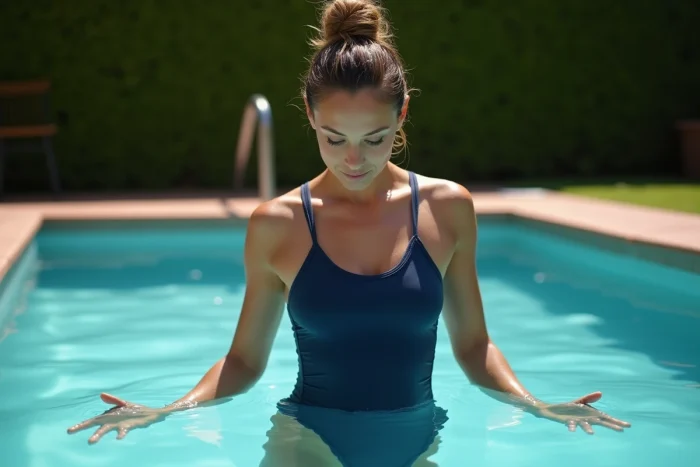
A human body with a density greater than that of water sinks, regardless of the swimming technique used. The average density of the body is very close to that of fresh water, which means that minimal variations in body composition can tip the balance one way or the other. Understanding why some people do not float in water first requires distinguishing between what is pure physics and what is perception.
Body Density and Buoyancy: The Role of Body Composition
Buoyancy depends on a simple ratio: if the overall density of the body is less than that of water, the body floats. If it is greater, it sinks. Fresh water has a reference density of 1, and the human body oscillates around this value.
Body fat is less dense than water, while muscles and bones are denser. A very muscular person with little body fat will tend to sink, even when perfectly relaxed. Conversely, a body type with more body fat facilitates floating without any technical effort.
Lung capacity also plays a direct role. Lungs filled with air act like internal floaters. Taking a deep breath and keeping the lungs inflated reduces the overall density of the body. Exhaling completely produces the opposite effect and can be enough to sink someone who was floating just a second before.
Those who seek to understand why I do not float in water often find that their body type is not to blame, or not as much as they thought. The next factor weighs at least as much in the equation.
Actual Buoyancy vs. Perceived Buoyancy: The Anxious Gap
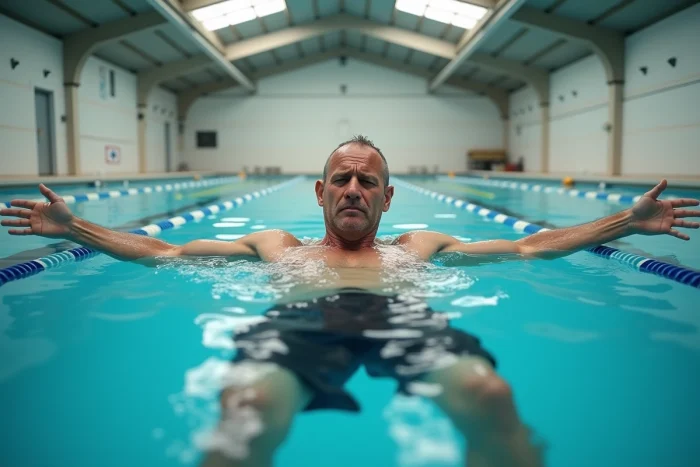
Feedback from lifeguards in municipal pools, presented during professional days between 2022 and 2024, reports a rise in adults consulting for a fear of not floating even though their objective buoyancy tests are within the norm. The problem is not physical; it is perceptual.
This gap between actual buoyancy and perceived buoyancy follows a precise mechanism. Anxiety triggers a reflex muscle contraction, especially in the legs and pelvis. The body stiffens, becomes vertical, and the lower part sinks. The person interprets this partial sinking as an inability to float, which reinforces the fear and increases tension.
Clinical reviews indicate that reducing anxiety and muscle tone is often more decisive than morphological characteristics for successfully floating. In other words, someone whose body density theoretically allows for floating can sink solely due to stress.
The Vicious Cycle of Tension in Aquatic Environments
Three phenomena are linked and self-perpetuating:
- The fear of sinking triggers muscle hypertonicity, particularly in the lower limbs, which then become denser and pull the body down.
- The partial sinking of the legs prompts the person to raise their head, breaking the horizontal alignment and worsening the descent of the pelvis.
- Breathing becomes short and erratic, reducing the air volume in the lungs and thus the overall buoyancy.
This pattern explains why swimmers capable of covering several lengths of the pool fail to maintain a simple back floating position. Technical skill does not erase the anxious reflex.
Letting Go Exercises and Back Floating: Regaining Confidence in Water
Professionals recommend short individual sessions focused on letting go before any swimming work. The goal is to dissociate the learning of floating from that of propulsion movements.
Assisted Back Floating
The starting point is to lie on the back in a pool where one can stand, with a supporter lightly holding the neck or lower back. The instruction is to completely relax the legs, without forcing them back to the surface. They will sink slightly, and that is normal.
Learning slow abdominal breathing in the back position changes the perception of buoyancy in just a few sessions. Taking a deep breath through the belly increases thoracic volume and stabilizes the body at the surface. Heart coherence, practiced out of the water and then gradually in the aquatic environment, helps reduce baseline hypertonicity.
Accepting Partial Sinking
Floating does not mean having the entire body out of the water. The majority of the body volume remains submerged, with only the face and part of the torso emerging. Accepting this physical reality removes a common source of panic among adults who discover swimming later in life.

Fresh Water, Salt Water, and Equipment: Adapting Practice to the Environment
Sea water is denser than fresh water due to its salinity. This extra density significantly facilitates floating. A person who sinks in a pool may float easily in the sea, simply because the liquid surrounding them is heavier.
The salinity level varies from one sea to another, producing very different floating experiences. In fresh water (lake, river, pool), the margin is much narrower, and body composition weighs more heavily.
Safety recommendations for the sea published by the Ministry of the Sea emphasize never testing buoyancy alone in open water, due to risks of fainting, panic, and cramping. A buoyancy aid is recommended as soon as one moves away from the shore, even for good floaters.
- In pools, working on buoyancy in a shallow basin with a supporter allows for progress without risk.
- In the sea, salinity helps, but currents and water temperature can cause unexpected muscle tension.
- A buoyancy aid, even a light one, allows focusing effort on relaxation rather than survival, which accelerates learning.
The difficulty in floating rarely stems from a single cause. Body type provides a physical framework, but muscle tension related to anxiety and the lack of practice in deep breathing often weigh more heavily. Working on confidence in the aquatic environment, with a professional and in a secure setting, changes perceived buoyancy long before the body changes.