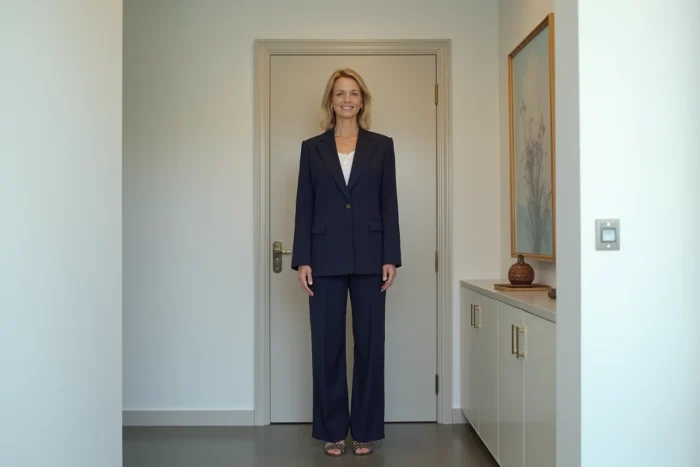
Rumeysa Gelgi measures 2.15 m. This figure, validated by the Guinness World Records, makes her the tallest living woman in the world. Her height results from a rare medical condition, Weaver syndrome, which causes accelerated bone growth and leads to severe complications throughout the skeleton.
Weaver Syndrome: The Medical Condition Behind the Height Record
Weaver syndrome is a genetic disorder that affects growth. Individuals with this condition experience accelerated bone maturation from birth, resulting in a stature well above average from childhood.
In Rumeysa Gelgi’s case, this condition has caused a continuous growth well beyond typical thresholds. The direct consequence: severe scoliosis, chronic pain, and reduced mobility that require her to use a wheelchair for most of her movements.
The syndrome is not limited to height. It affects facial structure, joints, and can lead to cardiac or respiratory complications. Every centimeter gained imposes additional pressure on bones, tendons, and internal organs. To learn everything about the tallest woman in the world, the medical dimension remains the necessary starting point before any fascination with the numbers.

Rumeysa Gelgi: A Holder of Multiple Records at Guinness World Records
Reducing Rumeysa Gelgi’s journey to a single record would overlook her trajectory. Even before being recognized as the tallest woman in the world in 2021, she already held the title of tallest teenager in the world, achieved before she reached adulthood.
Since then, the Guinness World Records has awarded her other distinctions related to her morphology:
- The record for the tallest woman in a wheelchair, a category that highlights the daily realities of her condition rather than just the spectacular aspect.
- The record for the largest hands for a living woman, a direct consequence of the accelerated bone growth characteristic of Weaver syndrome.
- The record for the longest back (measured length between the cervical vertebrae and the coccyx), a clinical indicator as well as a curiosity of records.
These complementary records tell something that the simple figure of 2.15 m does not convey. Each record reflects a concrete physical constraint: hands that cannot find suitable gloves, a back whose curvature requires ongoing orthopedic monitoring, a custom-designed wheelchair.
Guinness Certification Process: How a Height Record is Validated
The Guinness World Records does not rely solely on a measuring tape and a photo. The certification process for a human height record follows a strict medical protocol, little known to the general public.
The measurement must be performed by independent health professionals, standing when physically possible, or according to an adapted protocol if the person uses a wheelchair. The complete medical file is examined: bone imaging, diagnosis of the underlying pathology, history of surgical interventions.
Multiple measurements are taken at different times to rule out any variations related to posture or spinal compression throughout the day. A human can lose a centimeter between morning and evening due to the effects of gravity on the intervertebral discs.
The Guinness committee then cross-references this data with civil status declarations and medical reports from the country of origin. In Rumeysa Gelgi’s case, from Turkey, the file required certified translations and validations by Turkish and international doctors.
Why Some Historical Records Remain Contested
The oldest height records pose a reliability issue. Before the standardization of Guinness methods in the second half of the 20th century, measurements often relied on testimonies or post-mortem estimates. Zeng Jinlian, considered the tallest woman in history, was said to have reached 2.48 m according to Chinese sources, but this measurement has never been verified according to current protocols.
This distinction between historical records and contemporary records explains why Guinness separates the categories. Rumeysa Gelgi holds the record for the tallest living woman, which implies possible verification at any time.
Raising Awareness of Rare Diseases: Rumeysa Gelgi’s Public Role
Since 2023, Rumeysa Gelgi has been using her visibility to advocate for awareness of rare growth disorders. During public and media appearances, she emphasizes the daily medical complications rather than the spectacular aspect of her stature.
This approach goes beyond entertainment. Rare diseases affect few individuals, but their cumulative number represents a significant population. Weaver syndrome, for instance, remains so underdiagnosed that medical research still lacks solid epidemiological data.
In November 2024, Guinness organized a meeting in London between Rumeysa Gelgi and Jyoti Amge, the shortest woman in the world. The difference between the two: 153 cm. This staging fits into a deliberate strategy by Guinness World Records, which multiplies “contrast duos” to make an impression during anniversaries or special editions.
The meeting took place as part of the 70th anniversary of the record book. The two women were presented as icons of the Guinness World Records, an honorary title aimed at highlighting journeys deemed emblematic by the organization.
Rumeysa Gelgi’s journey shows that a world height record is not an isolated fact. It involves a medical diagnosis, a rigorous verification protocol, and increasingly, a public responsibility towards those who share the same condition without benefiting from the same visibility.