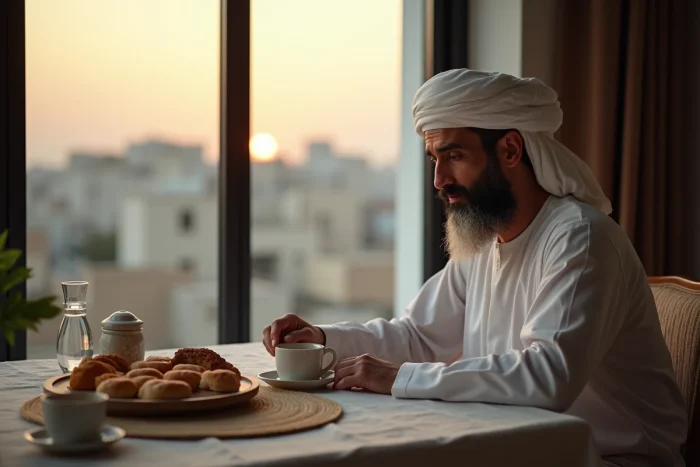
Imsak appears on many Ramadan calendars, sometimes displayed ten to fifteen minutes before fajr. Officially, this additional marker is not accepted by all religious authorities or all believers. For some, it is an unnecessary precaution inherited from local customs; for others, adhering to fajr, the true dawn, is sufficient. In the end, many waver, seeking a balance between fidelity to the text and the pursuit of tranquility.
Imsak and fajr: the two markers that signal the start of fasting
From the first days of Ramadan, the eternal puzzle of timing begins. When should one stop exactly: at imsak or at fajr? On most calendars, imsak serves as the first signal. It primarily means “abstinence” and exists only in tradition; no verse mandates it. It acts as a safety margin, as if there is a fear of missing the true start.
Fajr, on the other hand, is based on the Quranic word and prophetic practice. It is at the appearance of the famous “white thread” above the horizon, in a still dark sky, that one must cease all food intake. Ending the meal at fajr is to comply with the letter of the texts.
Among specialists, the rule is simple: only fajr counts. As long as dawn has not set in, continuing to eat remains permitted. However, the persistence of the dual marker fuels confusion. Conversations heat up, particularly around this question: should one stop eating at imsak or at fajr. Everyone wants reassurance, hesitating between caution and trust in official timings.
This choice, which seems technical, actually reflects a deep tension, that of staying as close to the text as possible without multiplying unnecessary obstacles in the daily life of the believer.
Why so much hesitation around stopping suhoor?
Suhoor, the last meal before dawn, concentrates all uncertainties: at what precise moment should one really stop? On one side is imsak, perceived as an additional precaution and widely relayed on calendars, and on the other is fajr, the only clearly established point of reference by tradition.
The origin of the divergences can be explained by several factors, as follows:
- The variety of interpretations of the texts of the Quran and hadiths
- The persistent ambiguity of the famous visual marker of the “white thread” in the morning
- The influence of local customs or the varying advice from religious authorities
In the past, the rule was clear: continue to eat until one can distinctly see the morning light that separates day from night. Since then, the fear of making a mistake, group pressure, or respect for majority habits has led many to stop suhoor well before. Timings have turned into shifting markers, part text, part collective requirement.
Additionally, the abundance of contradictory information and the proliferation of local calendars complicate matters. The dilemma of “imsak or fajr” then symbolizes this dual quest: to follow the rule while protecting oneself from doubt, without yielding to unnecessary precautions. This hesitation persists, crossing generations and borders, and reminds us how each Ramadan puts vigilance at odds with the simplicity of the spiritual act.

Navigating the timings and practicing with serenity
For many fasters, juggling imsak and fajr means adapting each year to complex timings and endless discussions. Calendars often provide two times: imsak, set a quarter of an hour before true dawn, and fajr, the direct legal and religious marker. This duality exists mainly to eliminate any ambiguity; but in daily life, it can also weigh on the conscience and disrupt unnecessarily.
The opinions of scholars are clear: it is the appearance of the first white light on the horizon (the white thread of the Quran) that ends the right to eat. Imsak, for its part, is mentioned only as a preventive reminder. It does not impose itself as an obligation but as optional caution.
To clarify all these difficulties, a few points can help:
- Opt for calendars validated by recognized authorities
- Take the food break at the precise time of fajr, not at imsak
- Consider local conditions and the actual time of dawn according to one’s region
Ultimately, this reflection on imsak and fajr goes far beyond a simple question of minutes: it touches on trust, fidelity to the text, and the desire not to add constraints where the rule is clear. And when the light of dawn gradually disperses the night, the choice of when to stop eating becomes the moment that connects each believer, alone before their plate, to the long chain of fasters from yesterday and tomorrow.