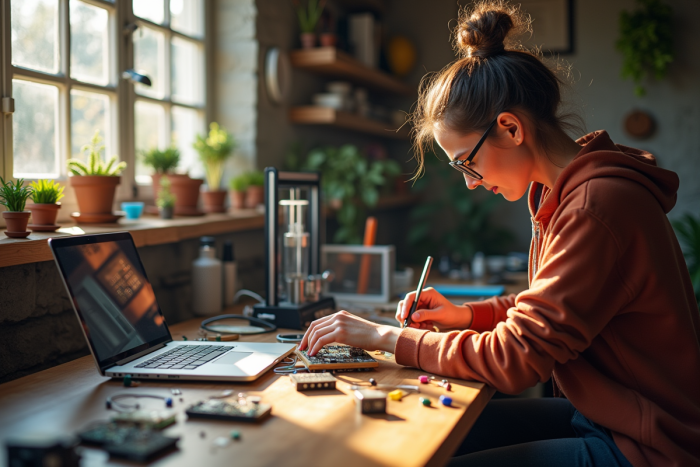
An opened toaster, a few LEDs planted in modeling clay that conducts electricity, and there you have it, the kitchen propelled into a testing ground. Among makers, the expectation of ready-made tools does not exist: here, we invent, we repurpose, we tinker, we shape our ideas without waiting for anyone’s permission.
Each transformed object tells a desire to escape user manuals, to free oneself from instructions to carve out one’s own path. 3D printers, microcontrollers, electronics kits: these tools erase the boundaries between thought and action, bringing within reach the possibility to shape one’s own version of the future.
Why Makers Are Reinventing Creativity in the Digital Age
In the workshop or on the living room table, the maker seizes technology, refusing to be just a consumer. The maker culture, built on sharing and open source, is part of a new generation industrial revolution, as perceived by Chris Anderson. This movement permeates French society, from urban neighborhoods to rural hamlets, weaving bridges between generations and diverse profiles.
Sociologist Isabelle Berrebi-Hoffmann speaks of true laboratories of social change. In these communities, amateurs and professionals come together: they pool their ideas, collectively solve technical puzzles, and unleash their creativity through mutual support and rapid prototyping. Makerspaces thus become bastions against planned obsolescence, advocating for the repairability of objects and lifestyles that are less resource-intensive. Clément Chabot, a driving force behind the Low-tech Lab, embodies this alliance between experimentation and ecology.
The tools developed by and for the community, like the Gertduino, open new horizons for the DIY movement. Featured in “Gertduino: a powerful tool for your DIY projects – Immersive Lab,” this device illustrates the makers’ ability to appropriate cutting-edge technologies and adapt them to their concrete needs.
- Open collaboration and collective intelligence
- Sharing skills and intergenerational transmission
- Local responses to technical and ecological challenges
The new generation of digital tinkerers is thus shaping a different way of inhabiting the digital world: creativity, resilience, and autonomy become the key words of a reinvented daily life.
Spotlight on Essential Tools That Stimulate Tinkerer Ingenuity
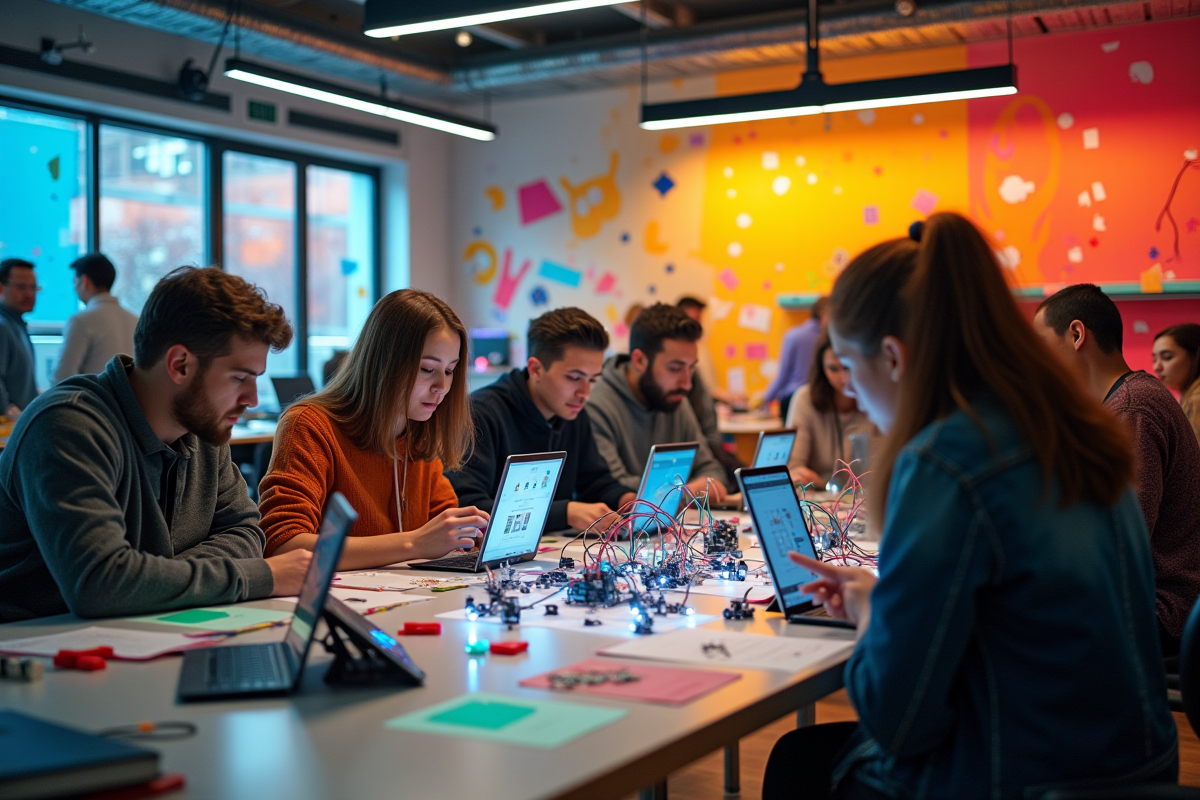
In the galaxy of makers, the diversity of tools fuels inventiveness. Fablabs and hackerspaces, like Electrolab in Nanterre where Sylvain Radix orchestrates a vibrant community, offer shared access to an arsenal of shared machines. 3D printers, laser cutters, CNC milling machines: these technologies transform a scribbled idea into a tangible prototype while encouraging knowledge exchange.
The 3D printer has established itself as the icon of the movement: creating a hard-to-find part, testing a novel solution, everything becomes a matter of hours rather than weeks. The laser cutter, on the other hand, pushes the limits of precision and allows for custom cutting of wood, plastic, or fabric.
- 3D Printer: giving shape to an idea at lightning speed
- Laser Cutter: surgical precision, multiple materials
- Shared Machines: divided costs, expanded access
Collective workshops, like fablabs, attract diverse profiles. Each person comes with their expertise, shares tips and methods, and together, they spark unexpected solutions. Key events, such as the Maker Faire France led by Christophe Raillon at the Cité des sciences, are a living demonstration of this: experimenters, curious individuals, and entrepreneurs converge, fueling a bubbling of ideas and projects.
The movement also relies on collaborative platforms. Pierre Banwarth, for example, documents his experiments on GitHub or instructables.com, facilitating the flow of knowledge and the duplication of inventions. This network of tools and places feeds a shared creativity that is always in motion.
Makers do not just repair what exists: they design possibilities, piece by piece, project by project. Where others see finished objects, they uncover hidden potential. And what if, tomorrow, the real technological revolution came from a screwdriver, a crazy idea, and a bit of audacity?