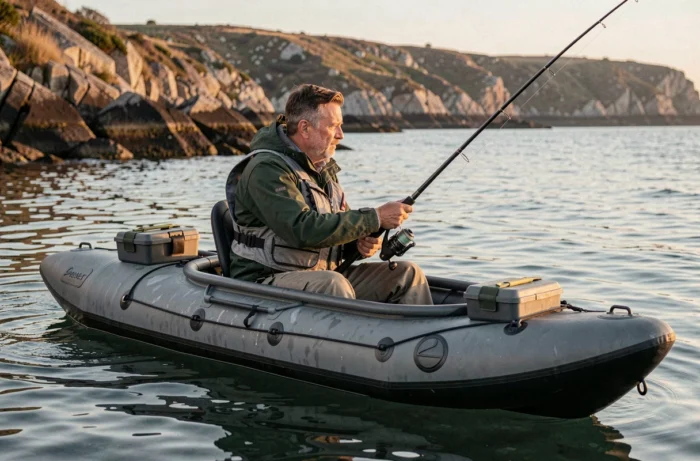
An inflatable sea kayak designed for fishing is not just a simple recreational kayak to which a rod is added. Sea fishing imposes load, stability, and regulatory constraints that eliminate a good portion of the models sold as “sea kayaks.” Understanding these constraints before purchase avoids disappointments on the water and sometimes dangerous situations.
Load capacity in fishing: the criterion that product sheets underestimate
Most choice guides focus on the weight of the paddler. In fishing, the calculation is quite different. You need to add the weight of the fisherman, that of drinking water, an anchor, a cooler for the catch, mandatory safety equipment, and, if applicable, a battery for a small fish finder.
The actual payload of an inflatable kayak is often less than what the manufacturer claims. The maximum capacity indicated corresponds to the limit before submersion, not to the threshold of comfortable navigation. Once this limit is approached, the waterline rises, stability decreases, and maneuverability deteriorates.
Before choosing an inflatable sea kayak for fishing, you should weigh all the equipment you plan to bring, add your own weight, and compare this total with about two-thirds of the maximum load announced. This ratio leaves enough margin for the kayak to remain maneuverable in coastal chop.
Stability of an inflatable kayak: width, pressure, and flat bottom
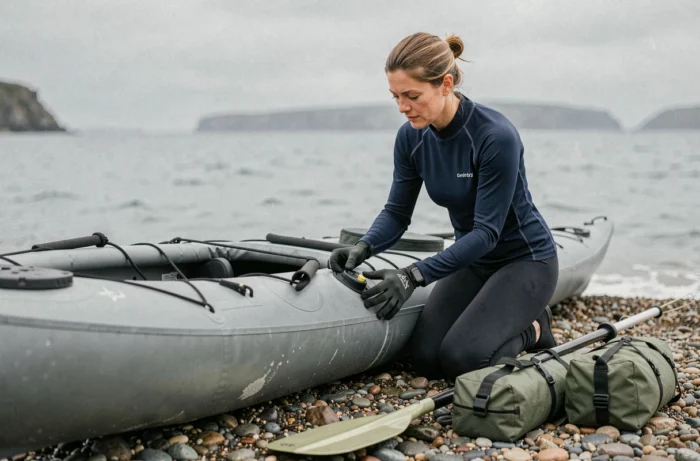
The stability of an inflatable kayak depends on three interrelated parameters. The first is the width of the hull. A wide kayak offers good primary stability, the kind you feel as soon as you sit down. For fishing, this stability is crucial: casting a line, reeling in a fish, or leaning to grab a catch requires reliable support.
The second parameter is the inflation pressure. A kayak inflated to low pressure deforms under weight and rocks with the slightest movement. Models designed for the sea accept higher pressures, which stiffens the structure and improves performance in waves.
The third is the shape of the bottom. A flat or nearly flat bottom stabilizes the craft at rest, which is suitable for static fishing. A V-shaped bottom improves tracking and glide but reduces lateral stability. For coastal fishing outings, a compromise between the two (slightly V-shaped bottom with wide side tubes) yields the best results.
Secondary stability and recovery after capsizing
Secondary stability refers to the kayak’s resistance when it begins to tilt. An inflatable kayak with large side tubes generally offers good secondary stability because the volume of displaced air increases with inclination.
The ability to reboard after capsizing is a regulatory requirement for navigating beyond the 300-meter zone. Test this maneuver in calm conditions before any offshore outing. Some models make reboarding very difficult due to overly high tubes or a deck that flexes under hand pressure.
Maritime regulations: what your kayak’s category changes concretely
One point that the majority of buying guides do not address with the necessary precision concerns regulatory classification. In France, a kayak shorter than 3.50 m can be considered a beach craft, limited to the 300-meter zone from the shore. For sea fishing, this area is often insufficient.
Beyond 300 meters and up to 2 nautical miles from a shelter, certain conditions apply:
- An individual flotation device of at least 50 N per person on board
- A device allowing reboarding after capsizing
- The kayak must meet regulatory requirements for watertightness, stability, and buoyancy to not be classified as a simple beach craft
Between 2 and 6 nautical miles from a shelter, the requirements become significantly heavier, including a waterproof and floating VHF radio for every two people. Before purchasing, ensure that the targeted model meets these criteria and that its length exceeds the regulatory threshold if you plan to fish beyond the coastal band.
Fishing accessories and deck layout: what makes the difference on the water
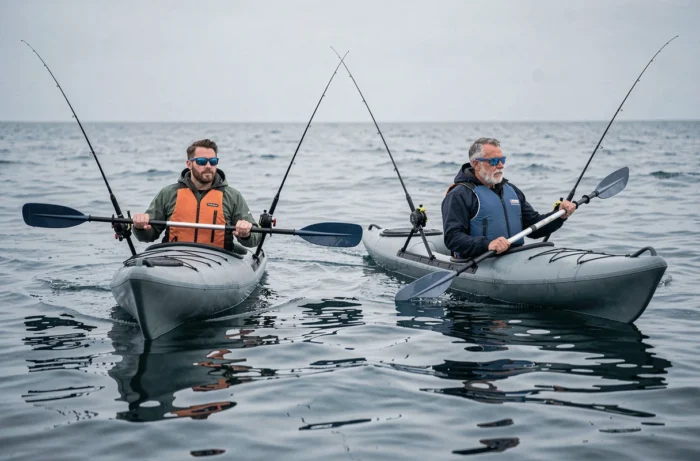
A general-purpose inflatable kayak and an inflatable kayak designed for fishing differ in deck layout. The elements to check before purchase:
- Anchoring points to secure a rod holder, anchor, or fish finder, without piercing the inflatable structure
- A storage space accessible within reach for the tackle box and small accessories, separate from the main storage compartment
- An elevated and adjustable seat that relieves the back on outings lasting several hours and offers a better casting angle
- Rails or compatible mounting inserts for standard market accessories
A kayak without mounting points forces you to rig unstable solutions that end up moving in the chop. It is better to choose a model with original designated spots, even if it costs more, than a recreational kayak on which you try to graft fishing equipment.
Materials and resistance to hooks
The multi-layer PVC remains the most common material for inflatable kayaks. For fishing, resistance to punctures matters more than for recreational use: a hook falling on the tube, a knife slipping, a shell caught on the anchor. Models with reinforced coatings on the bottom and sides withstand these repeated assaults better.
A repair kit should always be part of the onboard equipment. A slow puncture several hundred meters from shore turns a fishing outing into an emergency situation if no sealing means are available.
The choice of an inflatable sea kayak for fishing relies on a trade-off between actual payload, stability at rest, and regulatory compliance. A model that checks these three boxes, with a deck designed to accommodate fishing gear, will make each outing safer and more productive than a touring kayak repurposed from its original use.