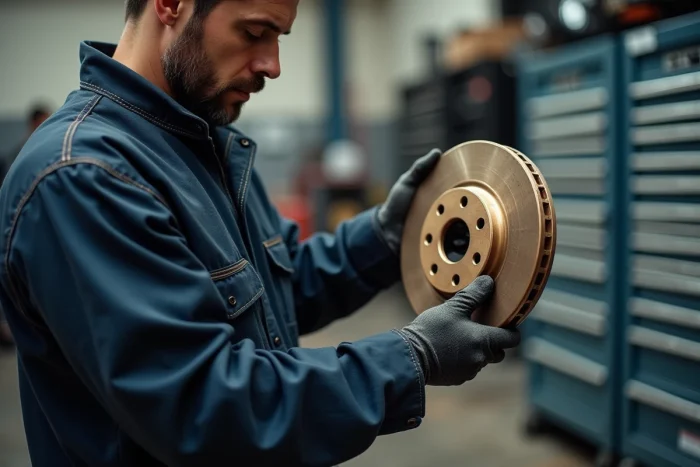
Ceramic brake discs, or more precisely carbon-ceramic (CCM for Ceramic Composite Material), have been equipping an increasing number of sports cars and premium sedans for several years. Long reserved for racing cars, this technology is now featured in the configurators of Porsche, Audi, Mercedes-AMG, and BMW M. The additional cost remains substantial compared to steel or cast iron discs, which raises a simple question: for what use is this choice truly justified?
Carbon-ceramic and regenerative braking on electric vehicles
The arrival of electric powertrains has changed the game for braking systems. On an electric vehicle, regenerative braking handles the majority of decelerations on a daily basis. Mechanical discs are engaged less frequently, which creates an unexpected problem: surface corrosion.
A cast iron or steel disc that brakes infrequently develops a layer of oxide. When the driver finally engages the mechanical brake (emergency braking, prolonged descent), the rust layer degrades the friction surface and increases the stopping distance.
Several premium manufacturers, particularly on the Porsche Taycan, certain variants of the Audi e-tron GT, and electric Mercedes-AMG models, offer carbon ceramic discs to limit this corrosion and maintain consistent braking performance over the long term.
The other argument put forth by manufacturers concerns unsprung mass. A ceramic disc weighs significantly less than a steel disc of comparable dimensions, which helps preserve range and improve dynamic behavior. For those who want to learn everything about ceramic brake discs, this combination of lightness and corrosion resistance explains the growing interest of the high-end electric market in this technology.
Ceramic braking performance at high temperatures: what tests show
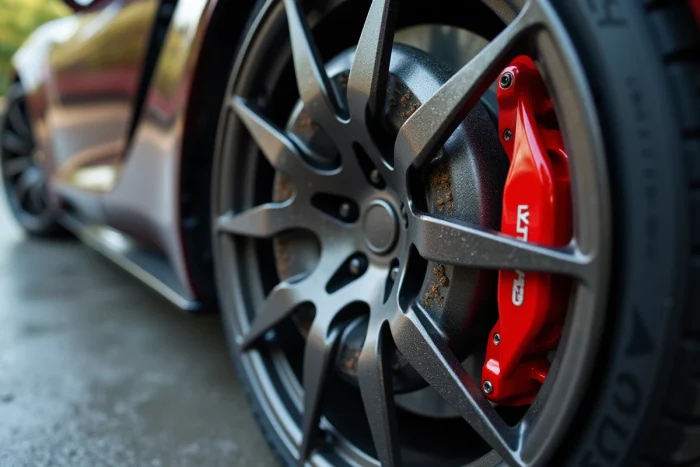
Comparative tests conducted by specialized press (Sport Auto, Auto Motor und Sport, Car and Driver) on Brembo CCM-R and Akebono systems highlight stable behavior at high temperatures. Where a cast iron disc loses bite after several hard braking sessions (fading phenomenon), the ceramic disc maintains consistent friction even under high thermal demand.
This observation is particularly evident in circuit use or intensive sporty driving. On open roads, most drivers never reach the temperatures where the difference becomes significant. Field reports documented on specialized forums like Rennlist or PistonHeads also confirm this gap between theoretical performance and actual use.
Wear and lifespan in real-world conditions
Theoretically, a ceramic disc lasts significantly longer than a steel disc. Feedback from independent workshops and tuners nuances this claim. Lifespan heavily depends on driving style, the quality of associated pads, and climate. A ceramic disc poorly paired with unsuitable pads wears out faster than expected.
Testimonials collected between 2021 and 2025 on specialized forums also show that surface microcracks, benign in some cases, worry uninformed owners. Distinguishing normal wear from a structural defect requires a diagnosis in a specialized workshop.
Brake particle emissions and Euro 7 regulation
Braking generates fine particles from the abrasion of discs and pads. These non-exhaust emissions represent an increasing share of particulate pollution from vehicles, particularly visible on electric powertrains (no exhaust to “mask” the contribution of brakes). The World Health Organization and the Joint Research Centre of the European Commission have documented the health impact of these particles in several publications between 2021 and 2024.
The Euro 7 regulation proposal, put forward by the European Commission in 2023, for the first time sets limits on brake particle emissions applicable to new vehicles. This regulatory framework could accelerate the adoption of less emissive materials. The available data does not yet allow us to conclude that ceramic emits systematically fewer particles than steel under all conditions, but SAE publications from 2021-2024 indicate a favorable trend for high-temperature carbon-ceramic composites.
Replacement cost and concrete selection criteria
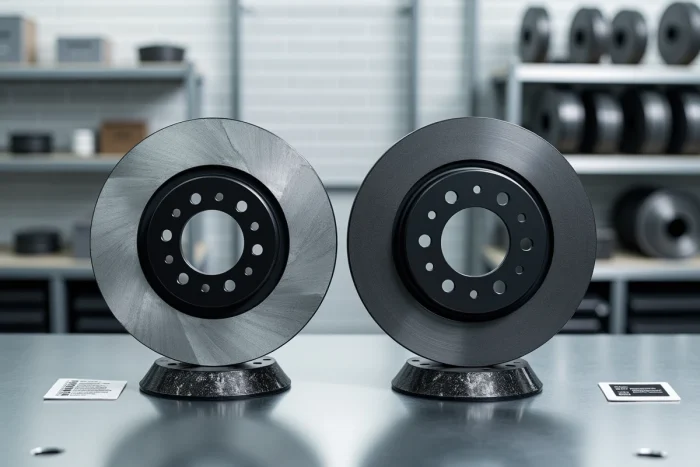
Price remains the main barrier (no pun intended) to the adoption of ceramic discs. The additional cost at purchase is substantial compared to a steel disc-pad set, and replacement is equally significant. Before checking the option in a configurator or searching the used market, several criteria should be clearly established.
- Usage profile: an exclusively urban and highway use does not engage the discs enough to justify the extra cost. The thermal advantage only manifests in sustained driving or on the track.
- Type of vehicle: on a high-end electric vehicle, corrosion resistance and the reduction of unsprung mass are solid technical arguments, not just marketing.
- Pad-disc compatibility: choosing pads specifically designed for a ceramic disc is non-negotiable. Poor pairing reduces performance and accelerates wear.
- Access to a competent workshop: diagnosing and replacing ceramic discs requires specific tools and expertise. Checking for the availability of a specialist in your area before purchase avoids unpleasant surprises.
Used: check the condition of the discs before purchase
In the used market, a vehicle equipped with ceramic discs can represent a good deal or a financial black hole. Feedback from tuners and independent workshops emphasizes the importance of a visual and tactile inspection of the discs. The presence of deep microcracks, chips, or asymmetric wear signals imminent replacement, the cost of which often negates the savings made at the vehicle’s purchase.
Having the discs inspected by a specialist before any transaction remains the most cost-effective precaution. Field reports vary on the acceptable wear threshold, making a professional’s opinion even more valuable.
Ceramic brake discs are neither a gimmick nor a universal necessity. Their relevance depends on a precise intersection of driving profile, vehicle type, and the ability to handle specialized maintenance. The Euro 7 regulation and the rise of electric vehicles could, in the long run, make this technology more common, but the cost-benefit ratio still needs to be evaluated on a case-by-case basis.